> For the complete documentation index, see [llms.txt](https://library.zoom.com/llms.txt). Markdown versions of documentation pages are available by appending `.md` to page URLs; this page is available as [Markdown](https://library.zoom.com/business-services/zoom-contact-center/expert-insights/integrate-zoom-contact-center-features-into-your-website/web-chat-and-video-configuration-tasks/advanced-features.md).
# Advanced Features
The Zoom CX Web SDK offers advanced features that enhance the solution's overall effectiveness. Although these features are optional, they contribute significantly to creating a more comprehensive experience.
***
### Passing Data from Your Website to Zoom CX
There are two methods available for sharing data from your website to Zoom CX:
* Website Data collection using the From Website Data feature
* Consumer Authentication
Both methods enable you to store information in Zoom CX Global Variables, but they serve different purposes and security levels.
#### **Website Data Collection Using the From Website Data Feature**
This method allows you to extract general data from your visitors' browsers, including:
* JavaScript variables
* LocalStorage
* Session storage
* Cookies
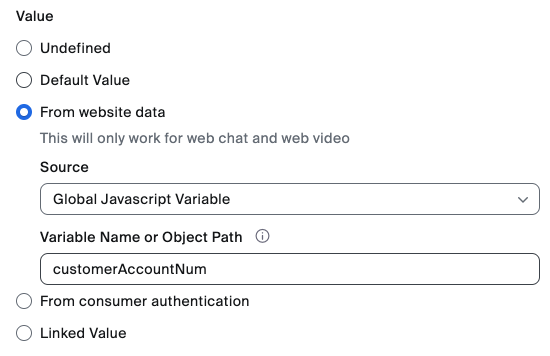
As part of the ZCX Global Variable configuration, admins can configure a mapping between the above website data components and ZCX Global Variable, as shown in the example below.
Once stored in Zoom CX Global Variables, the extracted data can then be utilized for things such as:
* Passing general webpage information (for example: current webpage info, items in a shopping cart, and so on)
* Enabling personalized experiences for all visitors
#### **Consumer Authentication**
This method is specifically designed for securely transmitting authenticated user information from your website to Zoom CX. It uses signed JWT (JSON Web Tokens) to ensure data integrity and authenticity, making it ideal for:
* Identifying known users
* Passing sensitive customer information
* Enabling personalized experiences for authenticated visitors
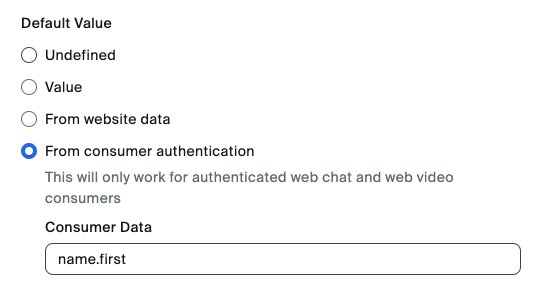
Both methods store data in Zoom CX Global Variables, but Consumer Authentication adds another layer of security through certificate verification so sensitive customer identification data remains protected. The image below shows how to extract data from the JWT and store it in a global variable. In this example, we extract the user's first name from the JWT JSON field name.first.
The Consumer Authentication feature requires that your website development team builds a special endpoint that serves the Consumer Authentication data, including the signed JWT.
For more information, see the following Zoom Support articles:
* [Global Variables](https://support.zoom.com/hc/en/article?id=zm_kb\&sysparm_article=KB0059058)
* [Website Data](https://support.zoom.com/hc/en/article?id=zm_kb\&sysparm_article=KB0059058)
* [Consumer Authentication](https://support.zoom.com/hc/en/article?id=zm_kb\&sysparm_article=KB0057542)
***
### Campaign SDK Methods/Events
Empower developers with programmatic control over the Zoom CX Web SDK for efficient management of engagement windows and invitations.
Through this functionality, developers can utilize their website's JavaScript front end code to seamlessly manage Zoom CX invitations and engagement windows, including automatically opening, closing, or hiding them.
For more information on the methods and events, check out the following developer documentation:
* [Zoom Contact Center](https://developers.zoom.us/docs/contact-center/)
* [Zoom Virtual Agent](https://developers.zoom.us/docs/virtual-agent/web/reference/)
---
# Agent Instructions
This documentation is published with GitBook. GitBook is the documentation platform designed so that both humans and AI agents can read, navigate, and reason over technical content effectively. Learn more at gitbook.com.
## Querying This Documentation
If you need additional information that is not directly available in this page, you can query the documentation dynamically by asking a question.
Perform an HTTP GET request on the current page URL with the `ask` query parameter, and the optional `goal` query parameter:
```
GET https://library.zoom.com/business-services/zoom-contact-center/expert-insights/integrate-zoom-contact-center-features-into-your-website/web-chat-and-video-configuration-tasks/advanced-features.md?ask=&goal=
```
`ask` is the immediate question: it should be specific, self-contained, and written in natural language.
`goal` is optional and describes the broader end goal you are ultimately trying to accomplish on behalf of the user. GitBook uses it to tailor the answer towards what is most useful for that goal.
The response will contain a direct answer to the question and relevant excerpts and sources from the documentation.
Use this mechanism when the answer is not explicitly present in the current page, you need clarification or additional context, or you want to retrieve related documentation sections.