> For the complete documentation index, see [llms.txt](https://library.zoom.com/llms.txt). Markdown versions of documentation pages are available by appending `.md` to page URLs; this page is available as [Markdown](https://library.zoom.com/zoom-workplace/zoom-meetings/securing-zoom-meetings-explainer/zoom-realtime-media-streams.md).
# Zoom Realtime Media Streams
As of June 25, 2025, Zoom offers Realtime Media Streams, which give developers direct access to rich, structured meeting data to unlock AI-driven insights, automate critical workflows, and build impactful integrations on the Zoom platform. Developers can reference [Realtime Media Streams documentation](https://developers.zoom.us/docs/rtms/?optimizely_user_id=03078374c135469fa2033b8a4833dc38\&DeviceId=b4f137e8-7d3f-4959-8869-8d3a7934e55e\&SessionId=1754350951481&_ics=1754350950680\&irclickid=~eb8ZWZ4~396XY52RUV28ZPQNSKEFwszqurujkab5YWLGFvpic96X&_gl=1*1r8vnfc*_gcl_au*MTUzNTIzNzY3MC4xNzUzMjgwMjYy*_ga*MTg3NjIzMzc5OS4xNzIzNDk1Mjcz*_ga_L8TBF28DDX*czE3NTQzNTA5NTAkbzE4MSRnMCR0MTc1NDM1MDk1MCRqNjAkbDAkaDA.) to get started.
### Enable Zoom RTMS to eliminate the need for third-party bots
Realtime Media Streams remove the need for third-party automated tools in meetings. Apps will receive per-participant structured data streams reflecting the context available to the user that authorized them.
By leveraging RTMS, developers can differentiate their apps, improve performance, and expand revenue opportunities. Additionally, enterprises are met with a solution to gain real-time access to their most critical conversations for insights, compliance, and enhanced workflows.
### Host controls and admin tools
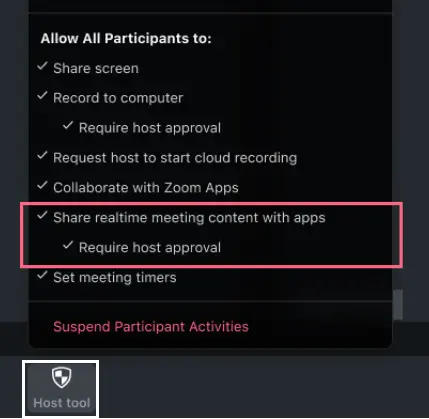
Account admins can enable RTMS and set RTMS auto-start toggles in the Zoom web portal. Additionally, hosts can use in-meeting host tools to control whether participants must request host approval to access meeting content.
#### Admin web portal controls
Admins can enable RTMS at the account, group, or user level within the Zoom Apps settings in the Zoom web portal.
Along with sharing real-time meeting content with apps, admins can choose to auto-start apps:
1. Under the Auto-start apps that access shared real-time meeting content setting, click Choose an app to auto-start.
2. Select the RTMS-enabled app or apps and set the Auto-start to On.
#### Host in-meeting tools
The following tools are available to meeting hosts:
* Share real-time meeting content with apps: Enable participants to share meeting content.
* Require host approval: Require participants to request approval from the host to access meeting content.
### Host in-meeting experience
The following screens are examples of disclosures, notifications, and AAN screens available to the meeting host.
#### Disclosure modal
The standard disclosure is displayed for the host and participants: “The content of this meeting is being shared with one or more apps.”
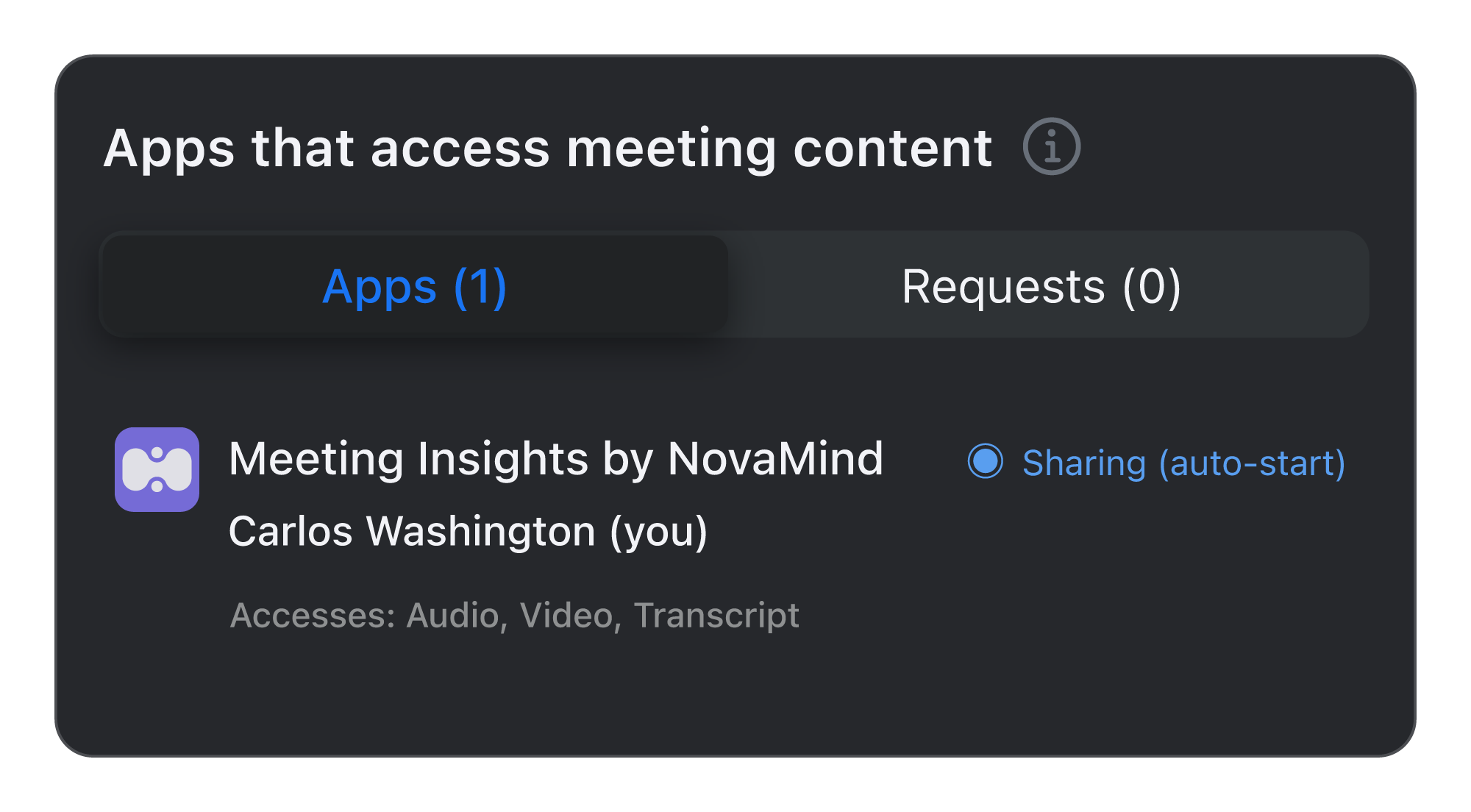
#### RTMS set to auto start
This is the host view of the AAN when RTMS-enabled apps are set to auto-start by the account administrator.
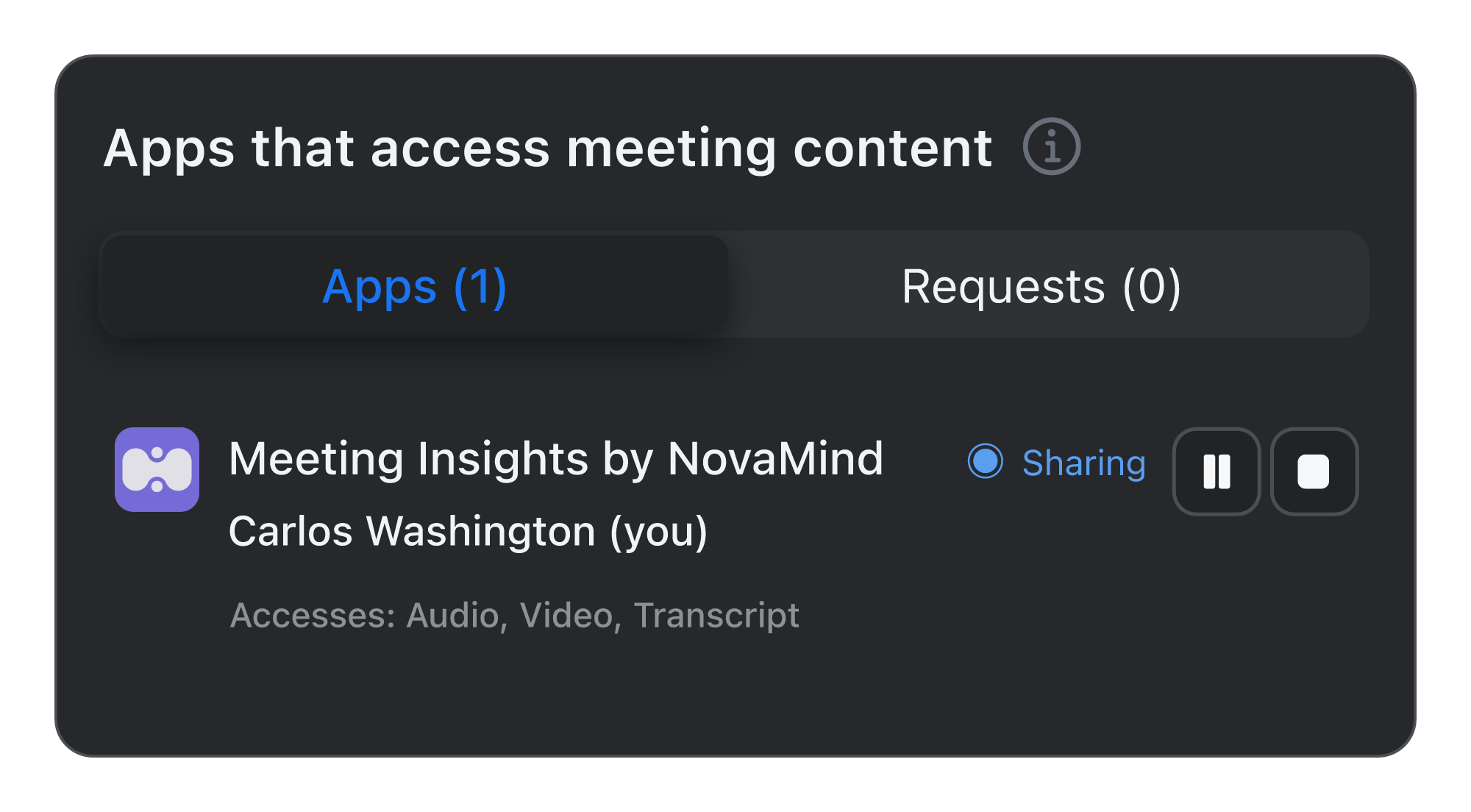
#### RTMS started by host
This is the host view of the AAN when RTMS is started by the host via app UI (JS API) or REST API. In this example image, you are Carlos Washington, the host.
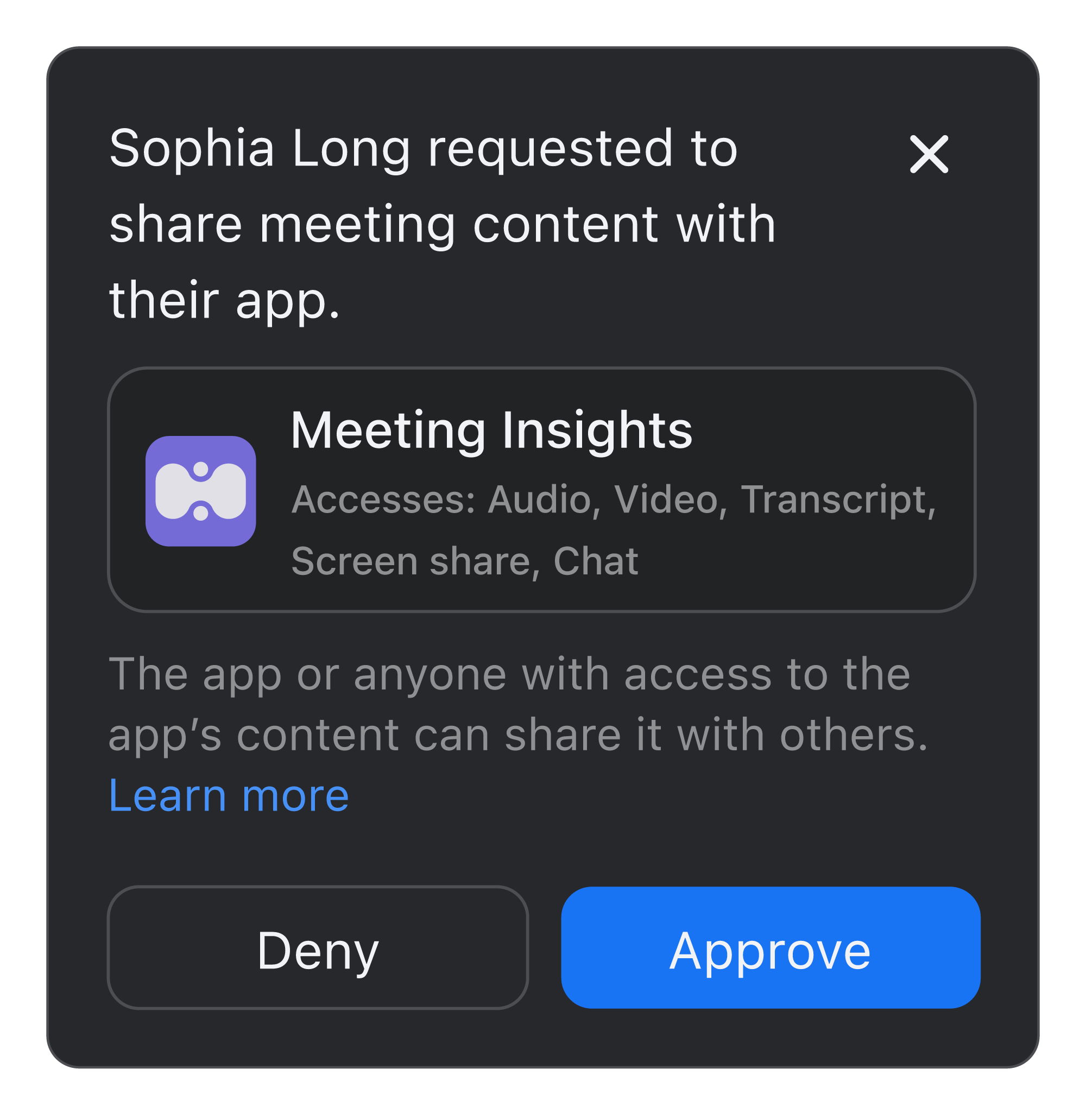
#### Request modal for a single app
This modal represents scenarios in which the host requires approval to share meeting content, and:
* The admin sets apps to auto-start from a different account than the host.
* Participants from the same or different accounts request to use an app in-meeting, initiated via the app (JS API or REST API).
This is the host view of the request modal for a single app. The host can approve or deny the request.
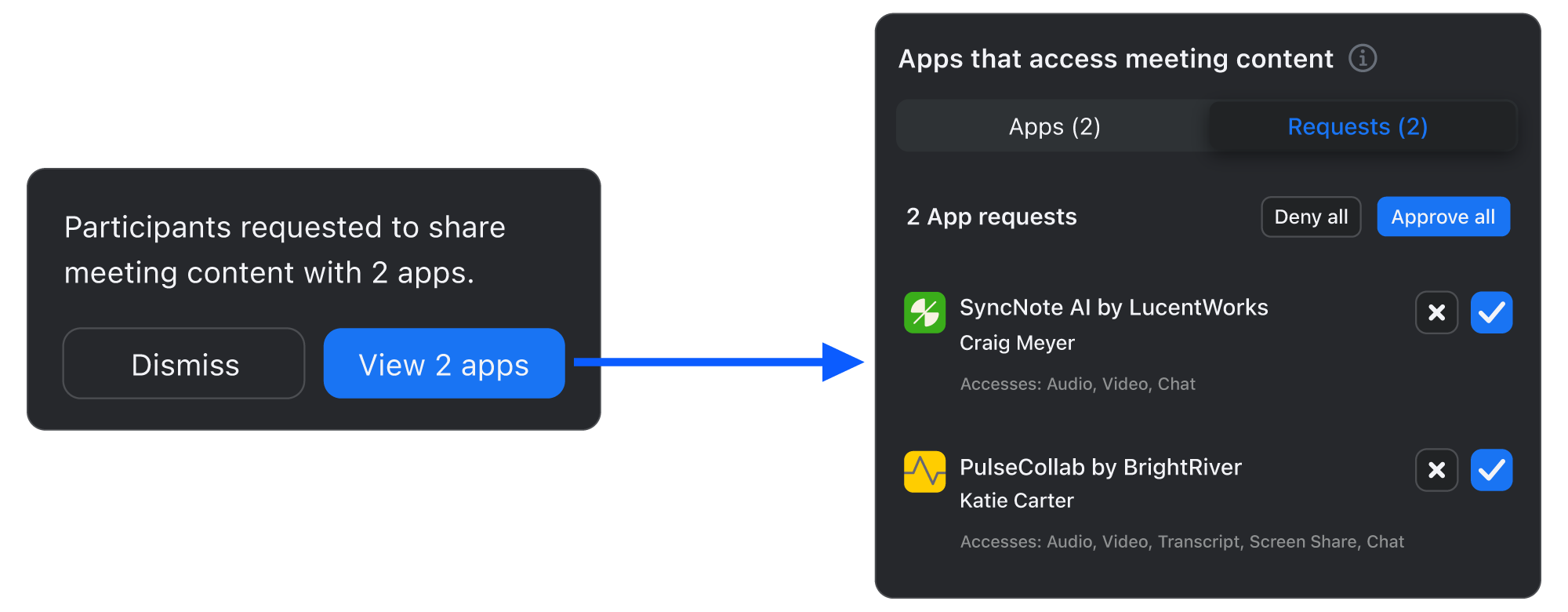
#### Request modal for multiple apps
The image below covers scenarios in which the host requires approval to share meeting content, AND:
* Multiple apps are requested by one or more participants.
* Multiple external admins set apps to auto-start for multiple participants from different accounts.
* Participants from the same or different account request to share content in-meeting.
This is the host view of the request modal for multiple apps. The host can approve or deny the request:
#### Apps actively sharing
This is the host view of the AAN of an approved app actively sharing content. It shows the name of the app, the app’s user, and the status as “Sharing."
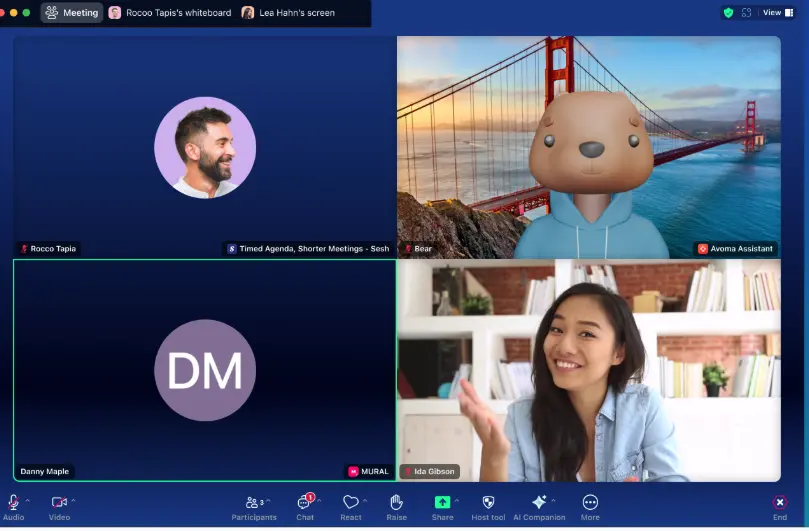
#### Video tiles
The video tiles view of active apps is the same for all meeting participants and the host. The name of the app used by the meeting participant is displayed in their video tile.
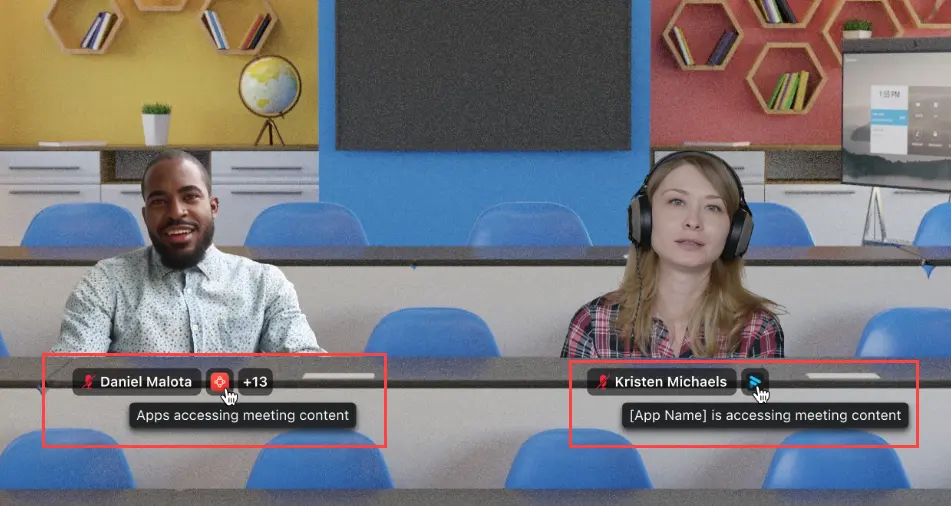
#### Immersive view
The immersive view of active apps is the same for all meeting participants and the host. The name of the app used by the meeting participant is displayed below their video image.
### Meeting participant user experience
The following screens are examples of disclosures, notifications, and AAN screens available to the meeting participants.
#### Disclosure modal
The standard disclosure is displayed for the host and participants: “The content of this meeting is being shared with one or more apps.”
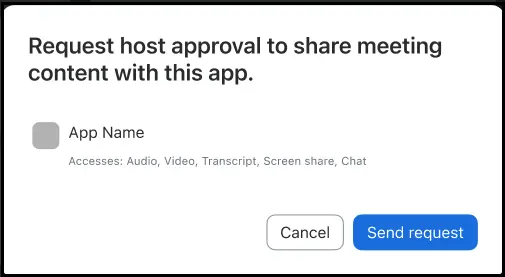
#### Request to share meeting content
This is the request modal participants use to request to share meeting content to the host.
#### Confirmation messages shown to participants
These are the available confirmation messages shown to participants in response to their request:
* Request sent to the host.
* Request for app to share meeting content denied by host.
* Host cannot approve your app’s access to meeting content.
* Host disabled your app from sharing meeting content.
* Request to share meeting content cannot be sent until the host has joined the meeting.
* Apps sharing meeting content have been disabled.
#### Video tiles
The video tiles view of active apps is the same for all meeting participants and the host. The name of the app used by the meeting participant is displayed in their video tile.
#### Immersive view
The immersive view of active apps is the same for all meeting participants and the host. The name of the app used by the meeting participant is displayed below their video image.
---
# Agent Instructions
This documentation is published with GitBook. GitBook is the documentation platform designed so that both humans and AI agents can read, navigate, and reason over technical content effectively. Learn more at gitbook.com.
## Querying This Documentation
If you need additional information that is not directly available in this page, you can query the documentation by asking a question.
Perform an HTTP GET request on the following URL with the `ask` and `goal` query parameters:
```
GET https://library.zoom.com/zoom-workplace/zoom-meetings/securing-zoom-meetings-explainer/zoom-realtime-media-streams.md?ask=&goal=
```
`ask` is the immediate question: it should be specific, self-contained, and written in natural language.
`goal` is what the user is ultimately trying to achieve, the reason they need the answer. Sharing it helps GitBook give you a better, more relevant answer. A goal is most helpful when it describes the outcome the user wants rather than restating the question. For example, with `ask=how do I create an API token`, a goal like `automate deployments from our CI pipeline` lets GitBook tailor the answer to that use case.
The response will contain a direct answer to the question and relevant excerpts and sources from the documentation.
Use this mechanism when the answer is not explicitly present in the current page, you need clarification or additional context, or you want to retrieve related documentation sections.